







Description
(soloBizOS) - Running a solo business offers freedom, flexibility, and unlimited growth potential. However, it also comes with a unique challenge: you are responsible for everything. From marketing and customer service to product development and administration, every task falls on your shoulders.
Without a structured daily plan, it is easy to become overwhelmed, distracted, or stuck working on low-priority activities. Successful solo entrepreneurs understand that productivity is not about working longer hours, it is about working on the right tasks at the right time.
In this article, you'll learn how solo business owners can effectively plan their daily work, stay focused on priorities, and create a sustainable system for long-term growth.
1. Why Daily Planning Matters for Solo Businesses
Unlike larger companies that have departments and teams, solo businesses operate with limited resources. Every hour spent on unnecessary activities directly impacts growth and profitability.
A daily work plan helps solo entrepreneurs:
+ Focus on high-impact activities
+ Reduce stress and decision fatigue
+ Improve time management
+ Increase productivity
+ Meet deadlines consistently
+ Maintain work-life balance
+ Achieve long-term business goals faster
Daily planning transforms a chaotic workday into a clear roadmap for success.
2. Common Challenges Solo Entrepreneurs Face
Before creating an effective plan, it is important to understand the typical obstacles solo business owners encounter:
2.1. Wearing Too Many Hats
A solo entrepreneur often acts as:
- CEO
- Salesperson
- Marketer
- Customer Support Agent
- Content Creator
- Accountant
- Product Manager
Switching between roles throughout the day can reduce focus and efficiency.
2.2. Constant Distractions
Emails, social media notifications, unexpected client requests, and administrative tasks can easily consume valuable working hours.
2.3. Lack of Prioritization
Many solo business owners spend time being busy instead of being productive. They complete easy tasks while delaying the activities that generate revenue and growth.
2.4. Burnout Risk
Without a structured schedule, work can quickly extend into evenings and weekends, leading to exhaustion and decreased performance.
3. The Ideal Daily Planning Framework for Solo Businesses
Successful solo entrepreneurs often organize their day around a simple framework:
3.1. Define Your Top Three Priorities
At the beginning of each day, identify the three most important tasks that will move your business forward.
Examples:
- Launch a marketing campaign
- Create a new product page
- Follow up with potential customers
If these three tasks are completed, the day can still be considered productive.
3.2. Separate Strategic Work from Routine Work
Not all tasks create equal value.
3.2.1. Strategic Tasks
These activities drive growth:
- Business planning
- Product development
- Marketing campaigns
- Content creation
- Sales activities
3.2.2. Routine Tasks
These activities maintain operations:
- Checking email
- Customer support
- Data entry
- Administrative work
Prioritize strategic tasks during your peak energy hours.
3.3. Use Time Blocking
Time blocking helps eliminate multitasking.
Example Schedule:
Morning (8:00 AM – 11:00 AM)
- Deep work
- Content creation
- Product development
Midday (11:00 AM – 1:00 PM)
- Meetings
- Client communication
Afternoon (1:00 PM – 4:00 PM)
- Marketing
- Sales activities
Late Afternoon (4:00 PM – 5:00 PM)
- Administrative tasks
- Planning tomorrow's work
This method improves concentration and reduces task switching.
3.4. Apply the 80/20 Rule
The Pareto Principle suggests that 80% of results come from 20% of activities.
Ask yourself:
Which tasks generate the most revenue, leads, or business growth?
Spend most of your time on those activities and minimize low-value work.
3.5. Review Progress Daily
Before ending the workday:
- Review completed tasks
- Evaluate productivity
- Identify unfinished work
- Prepare priorities for tomorrow
This habit creates continuous improvement and reduces morning uncertainty.
4. How to Plan Daily Work with soloBizOS.com
4.1. How to show todos list in soloBizOS.com?
Todo it, you need click on Works Daily (1) menu => then you click on Todo (2) sub-menu => now you can see todos list like Illustration 01 bellows:
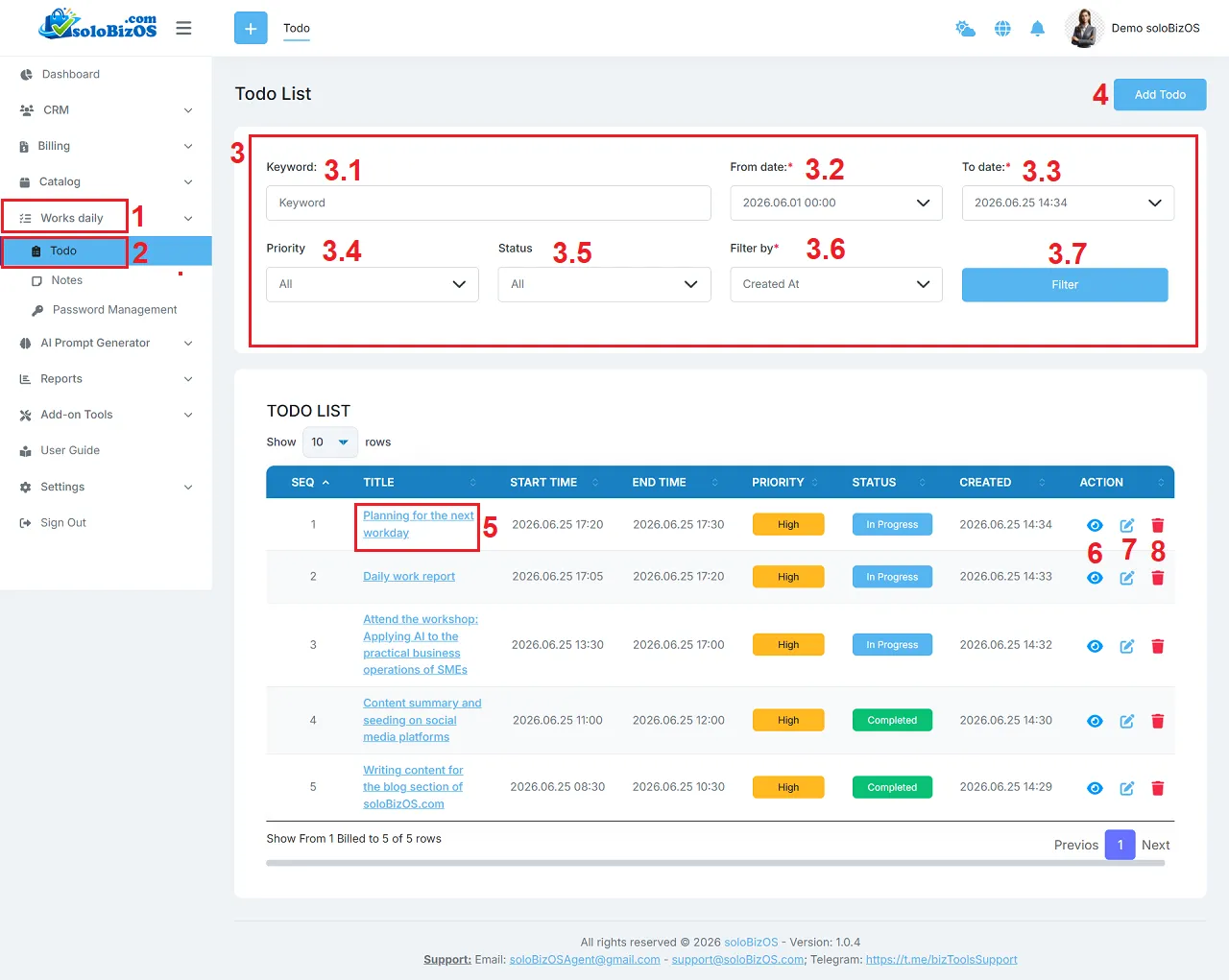
Illustration 01: Todos List
* Explanation:+ Add Todo (4) button: You click on this button to create a new Todo.
+ 3rd Area: It's used to filter data about todos.
+ Title (5) and Eye icon (6): You click on this to show Todo details.
+ Pencil icon (7): You click on this icon to modify that Todo.
+ Trush icon (8): You click on this icon to delete that Todo.
4.2. How to create a new Todo in soloBizOS.com?
In Todos List like Illustration 01 above, you click on Add Todo (4) button => In Todo Create form like Illustration 02 bellows, you need input all things for that form => Final, you click on SAVE (16) button to finish.
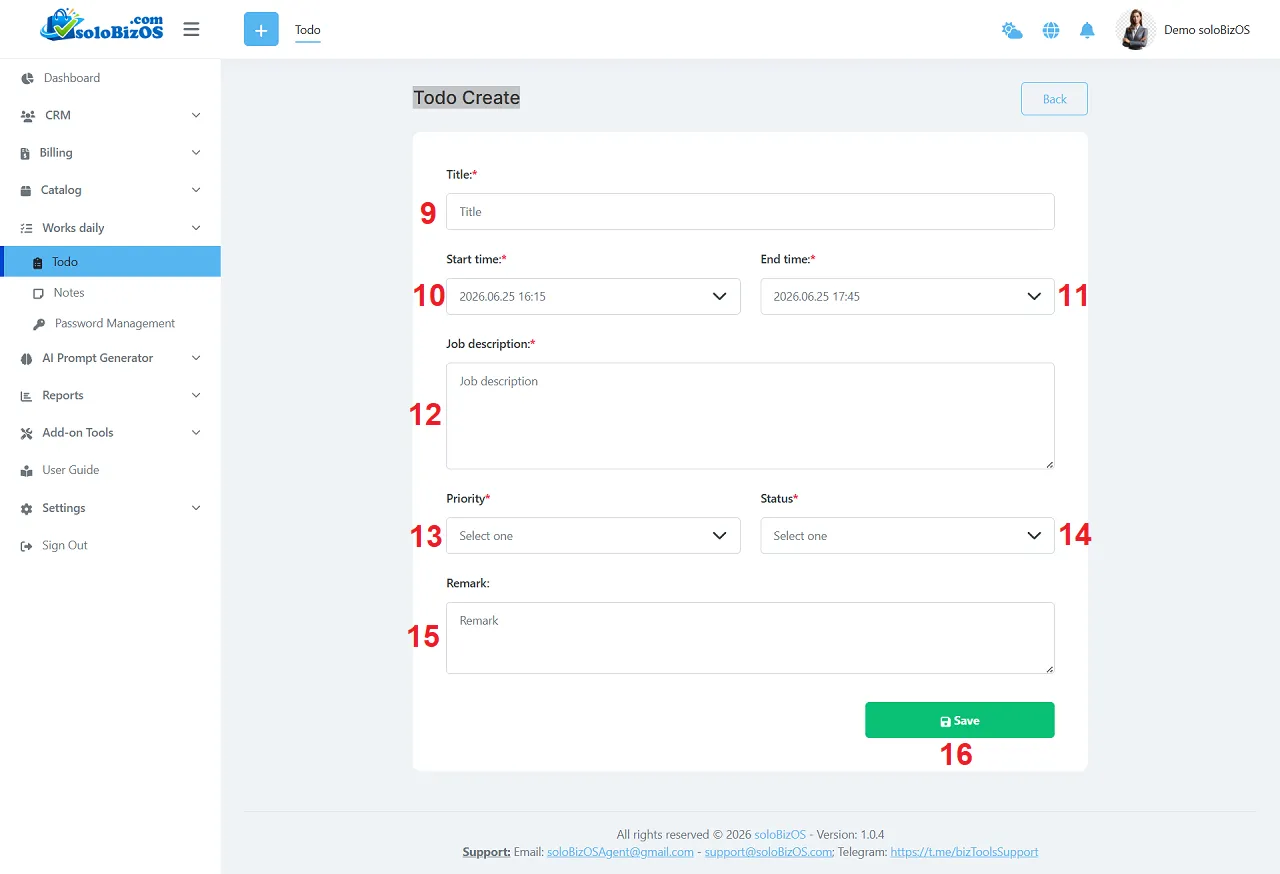
Illustration 02: Create a new Todo
5. Tools That Can Improve Daily Planning
Many solo entrepreneurs use digital tools to simplify task management and scheduling.
Popular categories include:
- Project management tools
- Calendar applications
- Time-tracking software
- AI productivity assistants
- Automation platforms
The right combination of tools can significantly reduce manual work and increase efficiency.
6. Best Practices for Staying Consistent
Daily planning only works when it becomes a habit.
Here are several best practices:
6.1. Start Every Day with a Plan
Never begin work without knowing your priorities.
6.2. Avoid Multitasking
Focus on one important task at a time.
6.3. Schedule Breaks
Regular breaks improve focus and prevent burnout.
6.4. Protect Deep Work Hours
Turn off notifications and eliminate distractions during focused work sessions.
6.5. Track Your Progress
Measure completed tasks and business outcomes weekly.
Consistency is often more valuable than intensity.
Conclusion
Planning daily work is one of the most important skills for solo business success. A structured plan helps entrepreneurs focus on high-value activities, reduce stress, and make consistent progress toward their goals.
By defining priorities, organizing tasks effectively, using time-blocking techniques, and reviewing progress regularly, solo business owners can accomplish more in fewer hours while maintaining a healthier work-life balance.
The most successful solo entrepreneurs do not rely on motivation alone they rely on systems. A daily planning system creates clarity, improves productivity, and provides the foundation needed for sustainable business growth.
*For any questions, please contact us via Email: soloBizOSAgent@gmail.com Or support@soloBizOS.com Or Contact us via Form CONTACT for a prompt response.